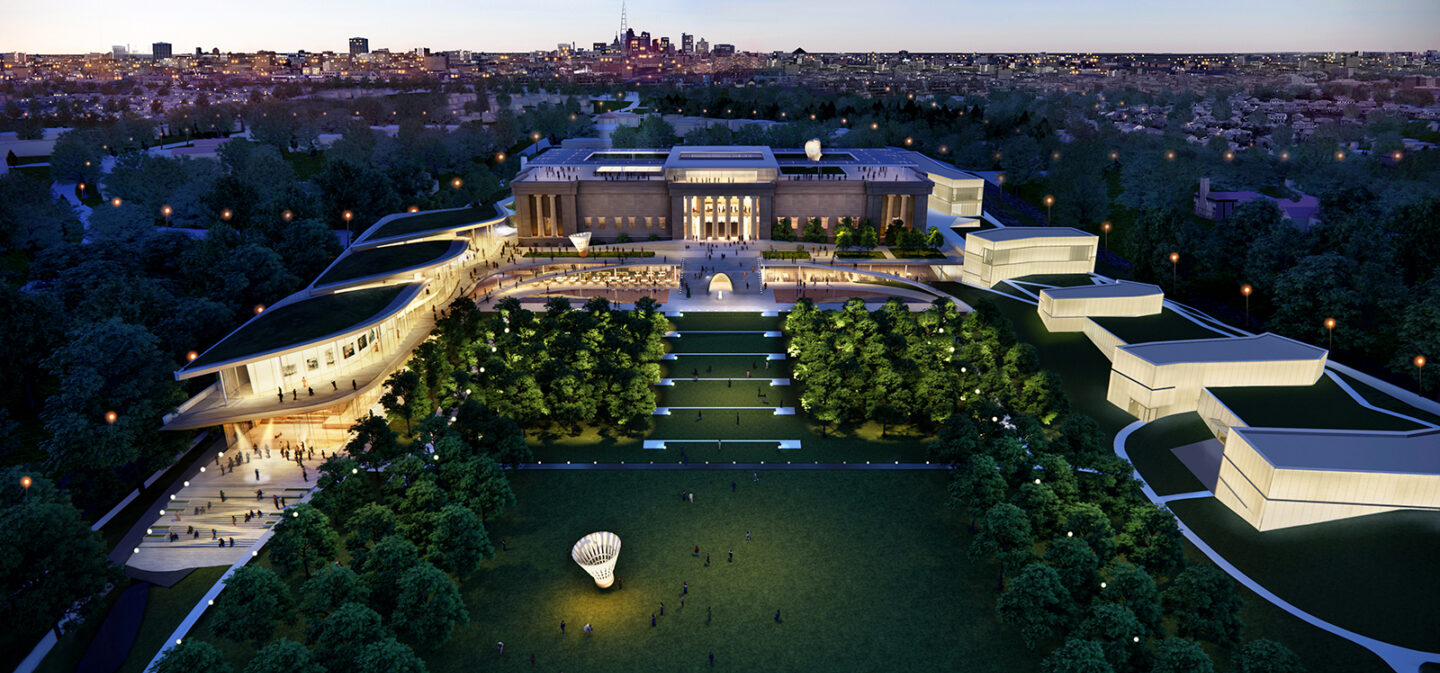
The Nelson-Atkins Museum of Art International Design Competition was a global open call for an outstanding architect-led multidisciplinary team to design a world-class addition for one of the United States’ finest art museums. One hundred and eighty-two teams submitted from more than 30 countries, and the competition website drew global audiences.
The Nelson-Atkins in Kansas City, Missouri cares for a superlative collection of more than 42,000 art objects and is best known for its extensive Asian art, European and American paintings, photography, modern sculpture, African, Native American and Egyptian galleries.
Rarely is a museum gifted with two architectural icons: an original 1930s Beaux Arts monument, and the much-admired 2007 Bloch Building by Steven Holl which introduced a luminous presence.
Now the Nelson-Atkins is embarking on a third evolution in response to rising an increasingly diverse attendance and a rapidly growing city. It aims to become a beacon of inclusivity, creativity and social connections. Strategically, the Board of Trustees is intent on expanding the conventions of the museum, so it becomes a more dynamic, open and inviting place – a place where everyone in feels they belong.
The competition’s program (brief) focused on delivering the museum’s strategic plan – highlighting art and forging a deep sense of belonging and community as core to their mission, expanding accessibility to art and creating a welcoming space for Kansas Citians. It challenged designers to create a 61,000 square foot expansion, encompassing a mix of entry, exhibition and program spaces, and the renovation of the 1930s building for the next generation.
In 2025, the museum’s Architect Selection Committee unanimously chose WEISS/MANFREDI’s proposed scheme – engaging architecture, landscape and community – as the competition’s winner.
Julián Zugazagoitia, Director & CEO of the Nelson-Atkins said:
‘WEISS/MANFREDI’s concept absolutely blew us away as it captured the spirit of the museum while offering a bold vision for our future.’